Gutter Installation in Eugene, OR: What the Rainy Season Reveals and Why It Matters Before Spring Arrives
Eugene's Rain Season Tests Every Gutter System. Here Is What Failing Ones Look Like.
The Willamette Valley gets about 47 inches of rain per year, most of it concentrated between October and April. A gutter system that handles summer's light rain without complaint often reveals its problems in November when the volume picks up and stays up for weeks at a time. Overflowing corners, sections pulling from the fascia, downspouts that discharge at the foundation instead of away from it. These are not new failures. They are failures that the summer dry season was hiding.
Getting ahead of those failures before the heavy rain season rather than reacting to them mid-winter is the better sequence. High Ridge Roofing & Gutters installs seamless gutters throughout Lane County, specifically engineered to handle Oregon's sustained rain volumes rather than occasional heavy events.
Why Eugene's Rain Pattern Is Different From Most Markets
Most gutter products are designed and rated for a national average rainfall distribution. Lane County's distribution is not average. The area receives concentrated, sustained rain during a prolonged season rather than distributed rainfall throughout the year. A system that performs adequately in a climate with monthly rain events faces a fundamentally different load when it is actively draining water for six months with minimal dry breaks.
The practical consequence is that undersized gutters, sectional systems with multiple failure-prone joints, and improperly sloped runs fail on an accelerated timeline compared to their rated service life. The rain is not more intense. It is more persistent. That persistence is what exposes the weaknesses.
What Failing Gutters Look Like in Lane County
Overflow at the corners during rain events is the most visible sign, and the most commonly ignored. Homeowners often attribute it to an unusually heavy rain. In the Pacific Northwest, overflow at the corners is almost always a slope or sizing problem rather than a volume anomaly. The gutter is not pitched correctly toward the downspout, or the downspout is undersized for the run, or debris has accumulated at the outlet and reduced flow capacity.
Water staining on the fascia or siding directly below the gutter line tells you the system has been overflowing consistently enough to leave a permanent mark. That mark represents ongoing water damage to the fascia board that will require repair before any new gutter installation can be done correctly. A fascia that is soft or rotted does not provide solid attachment for new gutters.
Foundation staining, soil erosion at the base of the home, and basement or crawlspace moisture that has no obvious interior explanation are the downstream symptoms of a gutter system that is depositing water too close to the home. These problems look like foundation or waterproofing issues. Often they are drainage issues that started at the roofline.
Seamless Gutters: Why They Perform Better in Oregon
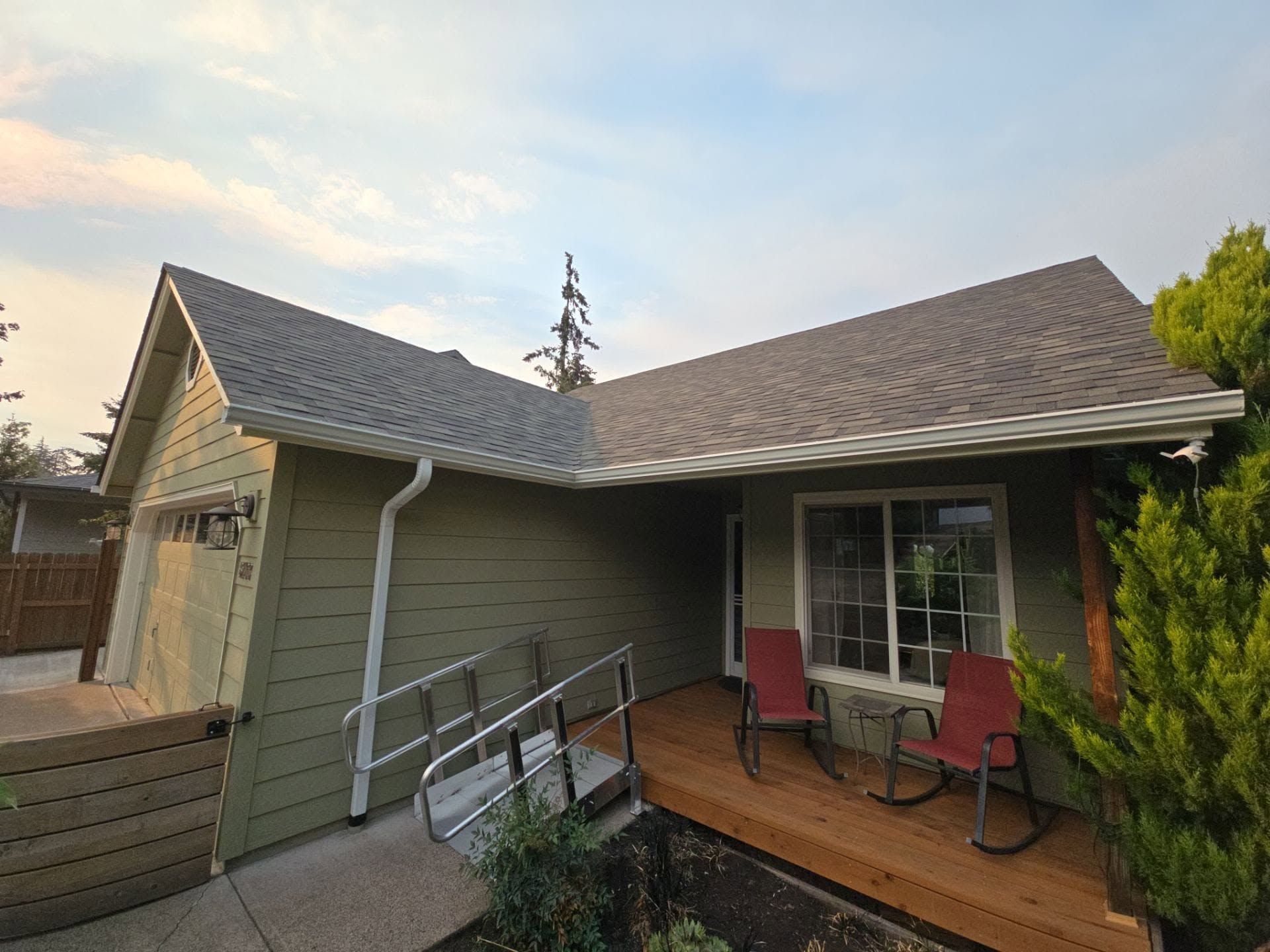
High Ridge installs seamless aluminum gutters, formed on-site to the exact length of each run. No joints between the corners and downspout connections means no seam failures. In a climate like Eugene's, where thermal cycling between dry summer temperatures and cool wet winters stresses every material joint, the absence of mid-run seams is a meaningful performance advantage over sectional systems.
Each corner on a High Ridge installation is hand-mitered. This reduces the total seam count in the system and means the corners are fit precisely to the specific roofline geometry rather than from a catalog of standard angles. Fewer seams across the entire system means fewer potential failure points over the life of the installation.
Gutter sizing matters more in this market than most. Standard 5-inch gutters handle typical rainfall volumes adequately, but homes with long uninterrupted roof runs, steep pitches, or significant tree coverage may need 6-inch gutters to handle the actual flow volume without overflow. High Ridge assesses each home before specifying a product rather than defaulting to a standard size.
High Ridge Roofing & Gutters: Eugene and Lane County
High Ridge is family-owned with offices in Springfield and Bend, serving Eugene and Lane County as part of its Willamette Valley territory. The team has been working Oregon gutters and roofs for decades. Malarkey Emerald Pro Contractor. Owens Corning Preferred. CCB #219802. BBB A+. 140-plus five-star reviews from homeowners across the valley.
Every gutter installation comes with a comprehensive inspection of the fascia condition and downspout placement before any product is specified. No pushy sales. Free estimates. Call (541) 357-4953 or contact the team online.
Schedule a Free Gutter Estimate in Eugene
If the rain season has already shown you something about your current gutter system, or you want to get ahead of the problem before it does, contact High Ridge Roofing for a free estimate. Call (541) 357-4953.
Frequently Asked Questions About Gutters in Eugene
How much rain do Eugene gutters need to handle?
Describe the item or answer the question so that site visitors who are interested get more information. You can emphasize this text with bullets, italics or bold, and add links.What size gutters do I need for my Eugene home?
Five-inch gutters handle most standard residential properties in the Eugene area. Six-inch gutters are worth considering for homes with longer uninterrupted roof runs, steeper pitches, or significant tree coverage that concentrates higher flow volumes at the gutter. High Ridge assesses the specific roof and drainage requirements before specifying gutter size.
What are seamless gutters and why do they perform better in Oregon?
Seamless gutters are formed on-site to the exact length of each run with no joints between corners and downspouts. Joints in sectional systems are the primary failure point over time, as thermal cycling between dry summers and cool winters stresses every material joint repeatedly. Fewer seams means fewer failure points
How do I know if my fascia needs repair before new gutters go on?
Soft or spongy fascia when pressed, visible rot or discoloration at the board surface, and gutter hangers that pull from the attachment point easily are all signs the fascia has deteriorated. High Ridge assesses fascia condition as part of every gutter estimate and addresses any needed repairs before the new system is installed.
Does High Ridge install gutter guards in Eugene?
Yes. Gutter guard installation is part of the service offering. Guard recommendations are based on the specific tree coverage around the property and the debris type the system collects. Eugene's significant tree canopy makes guards a practical consideration for homeowners who want to reduce cleaning frequency during the rain season.
How long does gutter installation take for a Eugene home?
Most standard residential gutter installations complete in a single day. Larger homes or projects requiring fascia repair before installation take longer. High Ridge provides a realistic timeline during the free estimate visit. Every installation ends with a final walkthrough confirming the system is properly sloped, securely attached, and clean.